
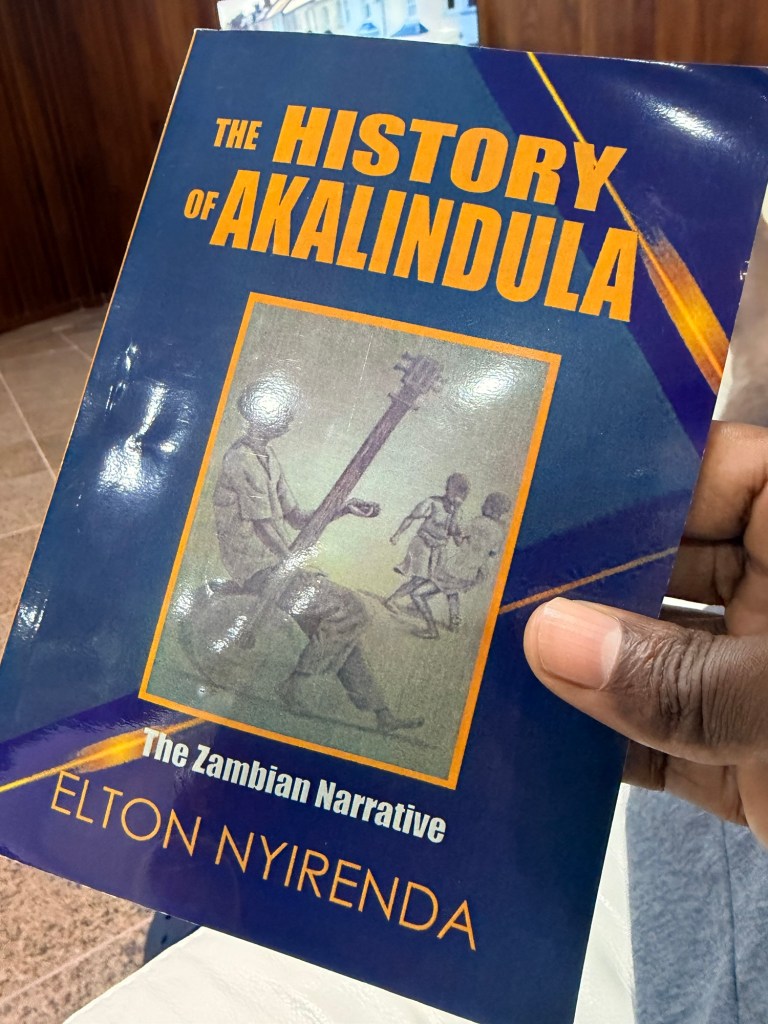
Review of Elton Nyirenda’s book “The History of Akalindula”
By Dr. Elias Munshya
This holiday season, my reading has included “The History of Akalindula”, by Elton Nyirenda. It is a commendable effort from one of Zambia’s finest music teachers and an important contribution to the growing conversation around documenting Zambia’s musical heritage.
I strongly agree with the author’s central call for a written and systematic history of Zambian music, and of akalindula in particular. While several academic and ethnomusicological studies on kalindula already exist, what is now required is synthesis. The scattered research needs to be brought together into a coherent historical narrative that is accessible to scholars, practitioners, and the general public alike.
One of the book’s strongest contributions is its clear positioning of akalindula’s origins in Luapula Province. The author persuasively shows that kalindula’s roots and early development are deeply embedded in Luapula, and that many of the genre’s key pioneers emerged from this cultural landscape. Figures such as Albert Muwe, Spokes Chola and the late PK Chishala rightly occupy a central place in this lineage. Any serious historical retelling of kalindula must therefore be situated within Luapula as its cultural and musical cradle.
That said, for a book published as recently as 2023, the discussion of urban kalindula could have gone further. The role of Chingola in the revival and modernization of kalindula deserved more detailed attention. While Sansamukeni Jazz Band is mentioned, no account of modern urban kalindula can be complete without a substantive examination of Chibesa and the transformative impact of the Glorious Band. Their work helped bridge rural kalindula traditions with urban audiences, contributing significantly to the genre’s resurgence and national reach.
Nonetheless, the book remains a strong and valuable beginning. It opens an important door and invites further scholarship that can build on its foundation with deeper regional studies, artist biographies, and critical engagement with urban kalindula movements.
The author, a music teacher at Chengelo School, brings both pedagogical clarity and genuine passion to the subject. The book is useful not only for music scholars and students, but also for lay readers with an interest in Zambia’s cultural history. Copies are affordable and accessible, with one currently retailing at approximately K150.
I would recommend this book to all kalindula enthusiasts, cultural historians, and anyone interested in understanding how Zambia’s musical traditions have evolved and endured. It is a solid contribution and, more importantly, a timely reminder that the work of documenting our music must continue, deliberately, collaboratively, and with historical depth.
This is a good beginning. The next chapter in writing the history of akalindula still awaits.
———
Rev. Dr. Elias Munshya is a Kalindula enthusiast and currently serves as Ambassador Extraordinary and Plenipotentiary of the Republic of Zambia in Angola.

Discover more from Rev. Dr. Elias Munshya
Subscribe to get the latest posts sent to your email.

 Rev. Dr. Elias Munshya